Tips for Indexing Conference Papers on Google Scholar (Step-by-Step)
 Admin
Admin
June 3 , 2026
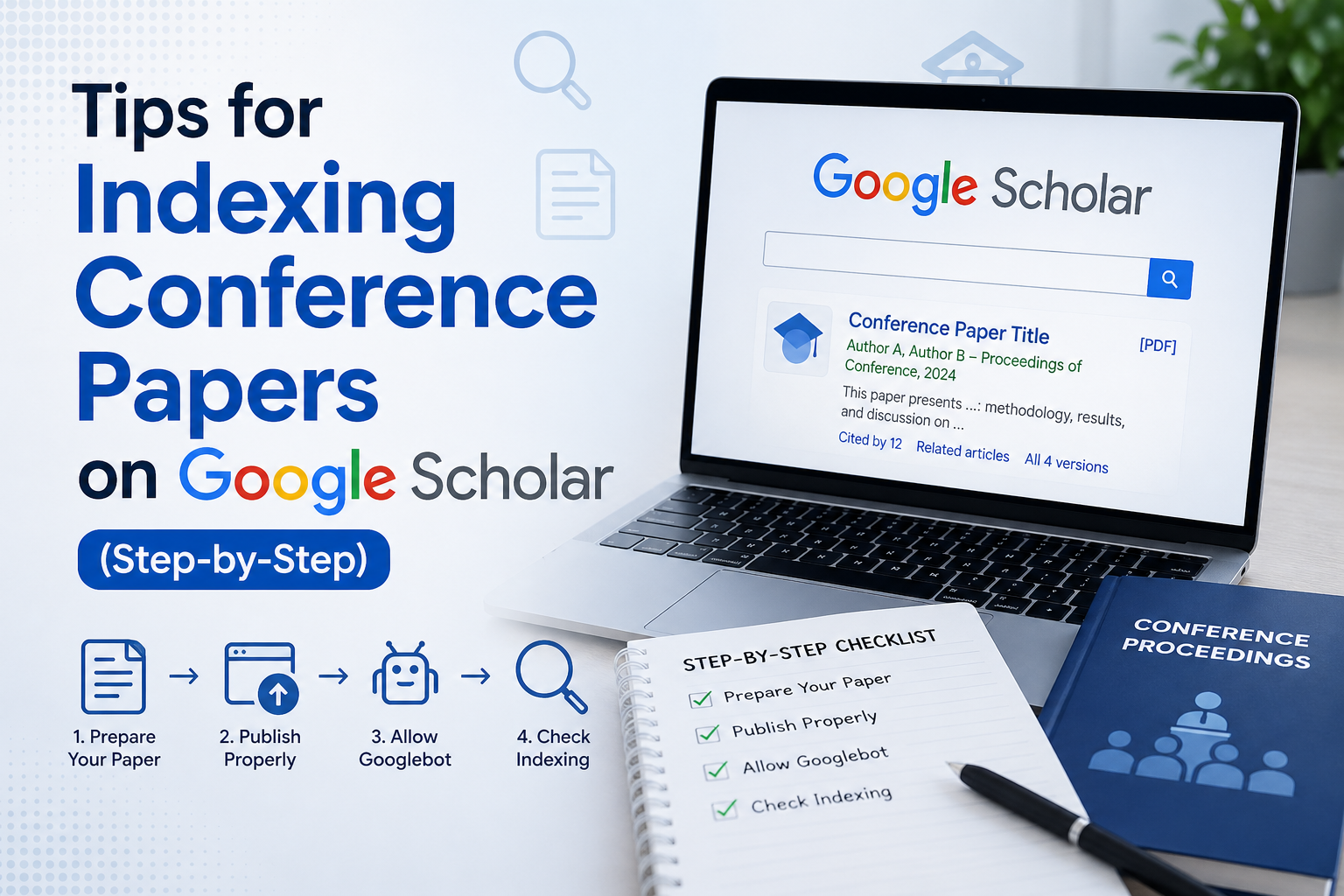
But many Google Scholar conference papers end up buried deep and fail to achieve the expected accessibility and impact. The main reason is that they are not correctly indexed on Google Scholar.
Now, the good news: There are some tips and technical criteria you should follow to improve the ranking of your Google Scholar academic journals.
Let’s explore:
Types of content Google Scholar supports
Google Scholar supports a broad range of academic and scholarly literature, including:
Google Scholar peer reviewed journal articles
- Research papers published in academic journals after peer review
- Google Scholar indexes full texts, complete with abstracts and citation data
Books and book chapters
- Scholarly books, their edited volumes, or individual chapters indexed separately
- Google Scholar indexes them with metadata, previews, citations, or full texts
Conference papers and proceedings
- Presenting new research at conferences
- Published in official proceedings
- Google Scholar indexes both abstracts and full papers
Thesis and dissertations
- Research projects with in-depth analysis, completed for graduate degrees
- Stored in university repositories
- Google Scholar indexes them for specialized studies that may not yet be available in peer-reviewed journals
Preprints
- Research papers before peer review for early feedback
- Google Scholar indexes them to help researchers track emerging ideas and advances before they are officially published
Technical reports
- Detailed documents describing research findings and methodologies
- Google Scholar indexes publicly available documents from reputable organizations
Court opinions
- Selected legal opinions from courts, providing judicial reasoning and legal precedents
- Useful for legal scholarship and policy research
Patents
- Legally registered new inventions and innovations
- Allows researchers to explore the developments and citations between patents
University repository papers
- Faculty publications, student research, datasets, and archived scholarship from digital repositories of universities.
- Google Scholar indexing improves visibility and provides open access to traditionally published academic work
Does Google Scholar Index Conference Papers?
Yes, Google Scholar indexes conference papers that are already published in a reputable academic source, like university repositories, official conference proceedings, preprint servers, or publisher platforms such as Scopus, IEEE, and more, which the academic search engine trends as legitimate and reliable.
But not all conference presentations are indexed in Google Scholar indexed journals. To qualify, the paper should be publicly accessible and formatted as a scholarly article with a proper title, author names, abstract, and references. Note that if you’re publishing in a conference, your paper should be uploaded to an indexed proceedings site or institutional repository. Google Scholar rewards visibility and accessibility.
Tips for Indexing Conference Papers on Google Scholar
Here are tips and strategies you can follow to increase the chances of indexing your Google Scholar conference papers:
Publish your conference paper(s) in official proceedings
As mentioned above, Google Scholar prefers papers published in official conference proceedings, reputable publishers like IEEE, Scopus, and academic journals. Otherwise, indexing on Google Scholar journals list becomes challenging.
Make papers publicly available
Google Scholar prioritizes freely available content. This means your conference paper must be publicly accessible on a website with no restrictions (like password-protected papers) for Google Scholar. Each paper should have a separate link, making it easier for search engines to locate and index them.
Structure papers with scholarly standards
Each paper page should follow a standard academic format: a paper title, author names, an abstract, clear section headings (Introduction, Methods, Results, Discussion), and a download link. Structure the web page so that each paper is identifiable. After all, clarity helps improve indexing.
Avoid duplicate URLs for the same paper
If a conference paper is published on multiple websites, Google Scholar might be confused about which version is correct. This can result in indexing errors or incomplete records. So, every paper must have only a single, properly defined URL for viewing and downloading the paper, as well as for different language versions.
Create and maintain your Google Scholar profile
When you add conference papers to your Google Scholar profile, researchers can find your work through author searches. Scholar provides a simple way to search for scholarly literature, associated citations, and full text. While a fully updated profile, including affiliation, research interests, and verified publications, does not guarantee indexing, it does indicate your professionalism and credibility, further increasing the visibility of your work.
Get support from reliable paper publication services
Using reputable paper publication services can make the submission and indexing process easier. An expert ensures your manuscript conforms to formatting, plagiarism, and the publisher’s requirements. They can also help you select reputable conferences or journals. All this help will improve your acceptance rate and indexing accuracy on Google Scholar. Just ensure that you select trusted and transparent paper publishing services backed with positive reviews.
Required Technical Criteria for Google Scholar Indexing
In addition to basic guidelines and tips, there are certain Google Scholar technical standards you must follow:
Free, public accessibility: The full text or abstract must be accessible without requiring a login or payment. Google Scholar does not index papers with such restrictions.
Dedicated web page: Each paper must have its own independent URL. The web page should clearly display the title, authors, publication date, and abstract in HTML language.
Searchable PDF format: Format your conference paper in text-based PDF. Google Scholar does not index scan-only or image-only PDFs that lack searchable text.
File size: Each file should be 5 MB or smaller. Larger files requiring OCR should be uploaded to Google Book Search.
The robots.txt file: The robots.txt file on your website must not block Google’s search algorithm from accessing your papers or URLs.
Complete bibliographic metadata: Keep metadata consistent and accurate. Incorrect formatting or missing citation details prevent proper indexing. The most common Google Scholar meta tags include:
- “Citation_title”: the title
- “citation_author”: Author names
- “Citation_journal_title”: Name of the journal
- “citation_volume”: Number of journals your article is published in
- “citation_issue”: Issue number of the journal
- “citation_firstpage”: Article’s first page number
- “citation_lastpage”: Article’s last page number
- “citation_abstract”: The abstract
Conclusion
Having your conference papers adhere to Google Scholar’s technical and formatting standards increases your visibility, credibility, and citations. The right structure, publicly accessible PDFs, and a dedicated web page for each paper setting—all are essential for effective indexing. This further helps achieve maximum research impact, academic exposure, and credibility in your field.
At AERP Conferences, we take great pride in being an independent, interdisciplinary conference organizer and research consultancy that promotes interdisciplinary discussion, cross-cultural awareness, and international exchange through educational and academic research. We also provide paper publication services, guiding researchers and authors at every stage of the publishing process so they can achieve their goals. If you have any questions or need our support with publishing your conference papers to a reputable platform, please do not hesitate to contact us.
FAQs
Does Google Scholar index conference papers?
Yes, Google Scholar indexes conference papers published in reputable official proceedings. The scholar prefers papers that are freely and publicly accessible and properly formatted for inclusion.
How can I get my conference paper indexed on Google Scholar?
Publish your conference paper in official conference proceedings or a reputable academic website. The paper should be publicly accessible, formatted according to academic standards for titles, author names, abstracts, references, etc.
What format should conference papers be in for Google Scholar indexing?
Google Scholar reads conference papers as PDF files. This means your paper should be in PDF format and structured with a clear title, author names, an abstract, and references.
Will uploading my paper to multiple websites improve indexing?
No, uploading your conference papers to multiple websites does not guarantee better indexing. You should prioritize publishing your papers in official proceedings and reputable institutional repositories rather than quantity.
Should authors upload conference papers to institutional repositories?
Yes, uploading to institutional repositories helps improve indexing because Google Scholar frequently crawls these websites. So, your conference papers have a higher chance of discoverability if they are published in institutional repositories.
Do conference organizers guarantee Google Scholar indexing?
No, conference organizers do not guarantee that your research papers will be indexed in Google Scholar. Indexing depends on accessibility, formatting, and how Google Scholar crawls the content.